
Slippery Jacks, Jills and cows: the yummy, delicate mushrooms in pine forests.
Slipperies

Slippery Jacks on the forest floor, surrounded by pine needles
Suillus species
There are three common varieties of Suillus mushrooms in the pine forest: slippery Jack - S. luteus- , slippery Jill - S. granulatus - and slippery cow - S. bovinus. There are also other microspecies and hybrids of the Suillus sp. They are very similar: all edible and grow in the same conditions and at the same time. All of them have an exclusive relationship with pine trees.
In this article we will show you how you can tell the main three apart, using identification clues, images, videos and references.
Slipperies are found in pine plantations across south-eastern and south-western Australia, under older trees where the pine needles are thicker. Depending on conditions (temperature and rain), they are in season from April to June. The Jacks are commonly found in clusters, growing one on top of the other, while the Jills and the cows tend to grow in groups but more dispersed. The older ones (three to seven days old) tend to get infested with slugs, so be quick to beat the these produce loving competitors.
Identification
The Suillus mushrooms are part of the boletus group (like the porcini), and unlike common field mushrooms (agarics group) they have pores in the underside. These pores are essentially small tubular holes that produce and expel spores when the mushroom is mature. When you look at it, this appears like a fine sponge. The main difference between slippery Jack, Jill and cow is that slippery Jack has a ‘skirt’, or ring around the stalk (annulus), while slippery Jill does not have a ring but fine grains dot the stalk and slippery cow has neither ring nor grains. You are looking out for a slimy mushroom growing under pine needles, with a sponge-like underside that is off-white turning a dirty-yellow.
There are several under-described native bolete mushrooms that grow in symbiosis with eucalyptus and other native trees. Please make sure you harvest from a pine forest or near a pine tree so as not to misidentify.
Cap
Brown in colour and up to 12 centimetres in diameter at maturity, the cap is initially globe-like, later flattening out. It is slimy to the touch, smooth and glossy even when dry. The skin (cuticle) is easily peeled off. Slippery Jack’s cap is the darkest brown, sometimes pale white if growing under foliage or other slipperies. Slippery Jill’s cap is a lighter brown while the slippery cow is creamy beige in colour, and the least slimey of the three.
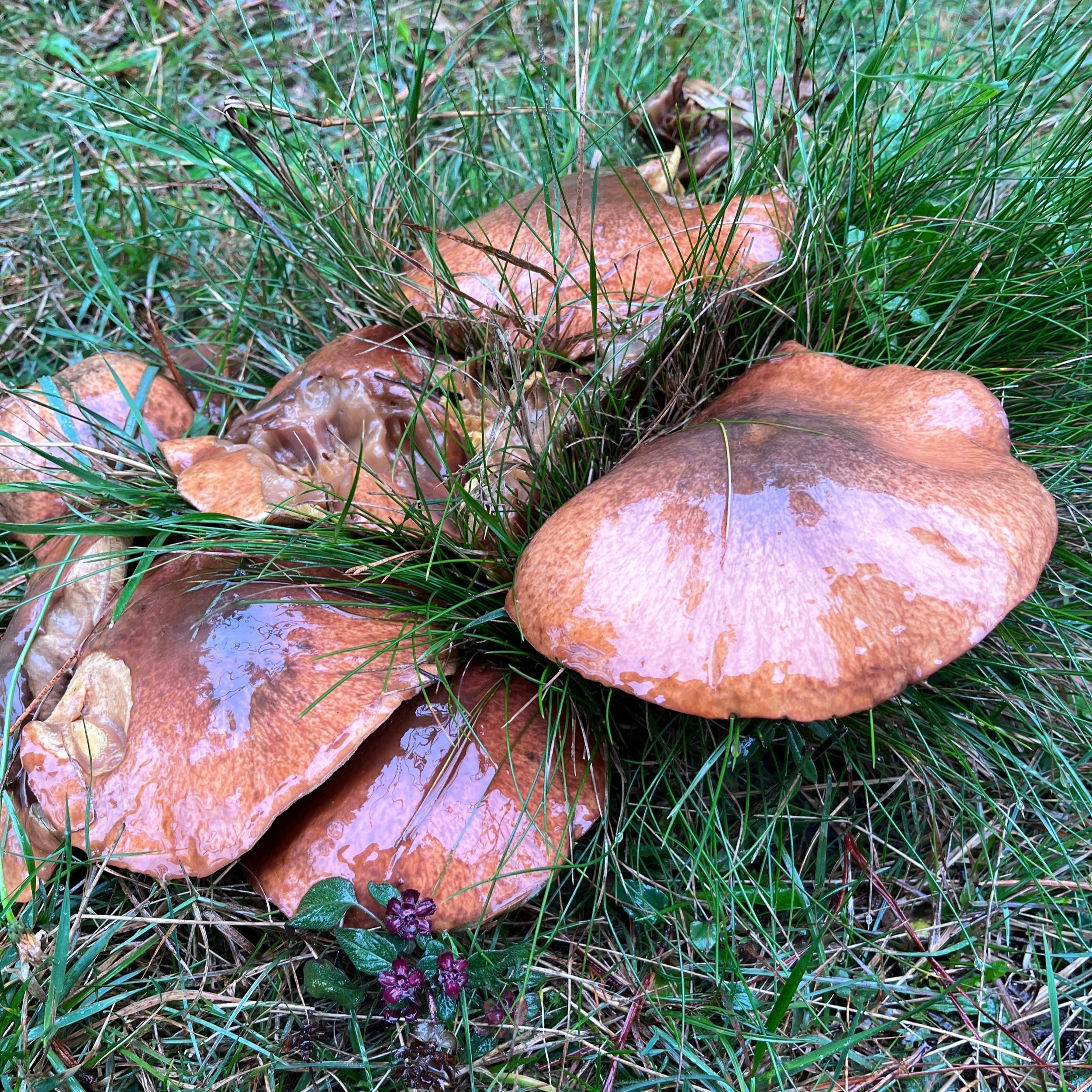
Slippery Jack- S.luteus
Slimey, dark brown cap, usually growing in clusters on top of each other.

Slippery Jill - S.granulatus
Slimey, lighter brown cap. Usually growing in groups.

Slippery cow - S. bovinus
Less slimey, growing in drier conditions and in groups.
Underside
Rather than gills, the spongy underside features tiny, circular pores; initially a light yellow in colour, they turn dark yellow to olive with maturity. In the slippery Jills the underside has a visible white sap coming out of the fresh specimen (see images), hence its other common name is weeping bolete. The slippery cow has pores that are rather big and visible.
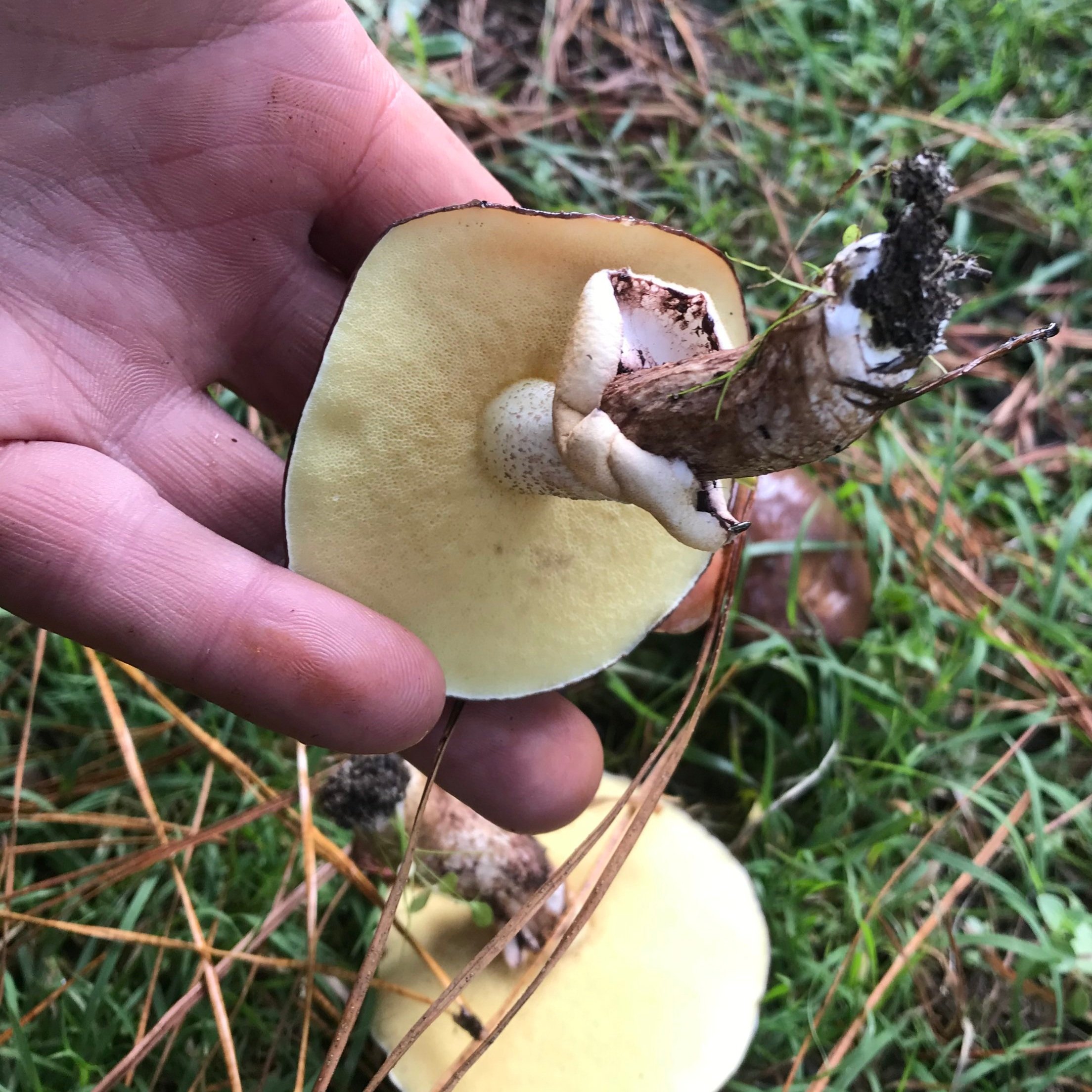
Slippery Jack with the typical veil peeling off the underside. It will leave a ring on the stalk that will disappear into purple markings.

Slippery Jill AKA weeping bolete with typical white drops of sap when fresh.

Slippery cow looks less slimey and with visible pores. No veil, no droplets.
Spores
The spores are clay to ochre in colour and can bee seen by doing a spore print. See here>
Stalk
White to cream in colour, stout, rather short at 2.5–5 centimetres long, and featuring a large veil/ring in the slippery jack. In young specimens, the veil is white and attached to the cap. It then darkens to purple-brown and detaches from the cap to form a ring, which in turn disappears in older specimens, leaving purple marks on the stalk. The slippery Jill has no veil/ring but visible markings like dots/grains ( hence the scientific name S. granulatum). The slippery cow stalk is slim, without a veil or markings and rather fibrous.
Flesh
Pale yellow or white, silky in texture.
VIDEOS
How to identify Slippery Jacks. Note the underside veil that peels off.
How to identify Slippery Jills- Suillus granulatus. Note the droplets of white sap in the underside of fresh specimen.
How to identify Slippery cow - Suillus bovinus. Note the absence of veil (annulus) and white sap. Also note the considerably bigger pores in the underside.
How to eat the slipperies
There are so many recipes for pine mushrooms, from simple fry-ups and risotto to mushroom pies.
There are also several ways to preserve this seasonal bounty. You can fry them in a pan and then freeze. You can add to soups, air-dry or dry them in a dehydrator. My favourite way to preserve them is to dehydrate until bone dry then blend until you get a powder of umami deliciousness.
Please note that it is best to peel the skin from these mushrooms before eating, as they can be heavy to digest. Sometimes, if the specimens are not so fresh, it is also advisable to remove the spongy underside.
A regularly cooked meal in Autumn at my house is ‘Slippery Risotto’. Such a warming, easy and tasty meal after a big day foraging in the forest.
Slippery Jack Risotto
Ingredients
Splash of olive oil
2 onions diced Juice of 1 lemon 30g good quality butter or nut butter 500g arborio rice 175 ml dry white wine 2 litres of veggie or mushroom liquid stock
Method
1.Pan fry your sliced slipperies in a good dollop of butter and cook until all the liquid has evaporated and they start to brown. Se aside for later.
2.Peel and finely chop the onions, grate the Parmesan, and zest the lemon.
3.Place the butter in a large pan over low heat with a drizzle of olive oil, add the onions and cook for 15 minutes, or until soft.
4.Turn the heat up to medium, pour in the risotto rice and stir for a few minutes to ensure every grain is coated. Stir well.
5.Pour in the wine and let it bubble away for a couple of minutes, stirring regularly. Start adding the stock bit by bit, stirring it through the rice and allowing it to be absorbed before adding more. Continue until the rice is cooked through – about 20 minutes.
6.Now add your cooked mushrooms and lemon or lime juice and stir with a wooden spoon to combine well.
7.Serve with a wedge of lime or lemon and a sprinkle of fresh herbs.
8.If you want to add another foraged element, Rambling dock (Sydney) or Wood sorrel, (mountains) are both complimentary fresh lemony and flavoursome garnishes to this Autumnal dish.
Marnee's hot tip.
Use risotto leftovers to make delicious arancini balls. Yuuuum!
Reference:
bie.ala.org.au - Map distribution of Suillus species in Australia
Wikipedia - Slippery jack
Wikipedia - Slippery Jill
Wikipedia - Slippery cow
Morrie2.com - An article on the Suillus of Western Australia
ligayagarden.online - on Slippery jack
foragersyear.wordpress.com - on slipperies
milkwood.net - on slipperies + recipes
